How-Tos
How to Find Your Personal Style
Your personal style is not something you pick from a quiz or a Pinterest board. It is something you notice, over time, in what you keep reaching for. This guide walks through the actual process: what to look at, what to write down, and how to test before you spend anything.
At a Glance
- Start with your closet, not a shopping trip. What you already reach for is more honest data than any quiz.
- Build a reference board over two to three weeks and look only at the clothes, not the styling, model, or setting.
- Find the overlap between your closet audit and your board; that overlap is your actual recurring taste.
- Name three to five concrete style words and use them as a four-second filter before every purchase.
- Test with a small eight-to-twelve-piece capsule for two weeks before buying anything beyond one or two gap-filling pieces.
- Revisit the whole process about once a year. Taste shifts with life changes, and that's normal, not a failure of the system.
Start with what you already own
Before buying a single new thing, go through your closet. Not to purge. Just to look.
Pull out every item and ask two questions: Does this feel like me when I wear it? And do I actually put it on, or does it just sit there?
You will find two piles forming. One is the stuff you reach for without thinking: the jeans that fit right, the jacket you wear on hard days, the dress that makes you feel sharp. The other pile is the aspirational stuff: the blazer you bought for the version of yourself you planned to become, the floral skirt that seemed like a good idea in the store.
The first pile is your real data. That is where your personal style already lives. As a rough benchmark, if fewer than a third of the items in your closet end up in the "reach for without thinking" pile, that's a sign your buying habits and your actual taste have drifted apart, which is common and just means the audit is doing its job.
What to note
- Silhouettes: Do you gravitate toward fitted or relaxed? Cropped or long?
- Fabric: Do you keep reaching for cotton and denim, or do you prefer satin and silk?
- Color: Are your favorites neutrals, or do you wear color without thinking about it?
- Formality: Is most of your go-to pile casual, put-together, or somewhere in between?
Write it down. Even a rough list on your phone works. If you want a slightly more structured version, count how many pieces in your go-to pile fall into two or three colors total; most people are surprised how narrow their real palette already is compared to what's actually hanging in the closet.
Build a reference board (but do it honestly)
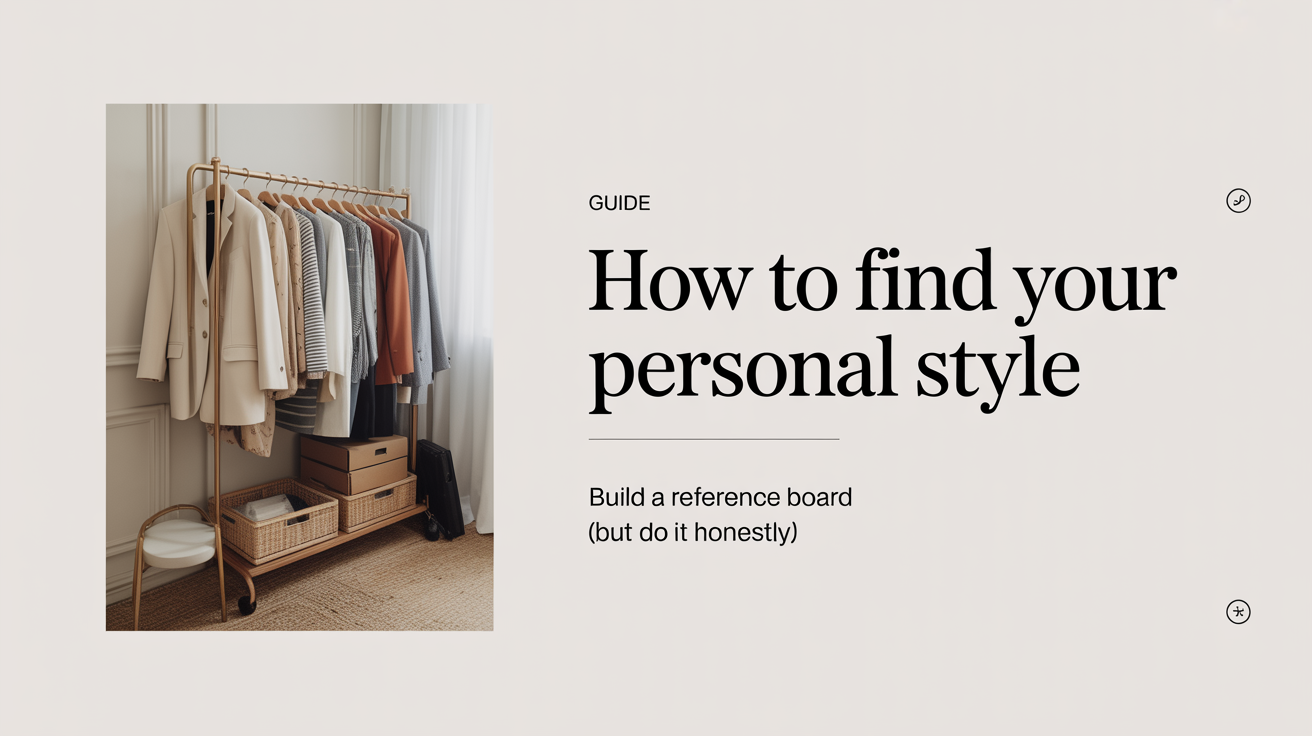
Mood boards get a bad reputation because most of them become wish lists that have nothing to do with your actual life. Avoid that.
Open Pinterest, Instagram, or a folder on your desktop. Save images of outfits that make you stop scrolling. Not because they look expensive or editorial, but because something about them feels right. Do this for two or three weeks. Don't curate as you go.
At the end, look at what you saved. Ignore the context: the model, the location, the styling. Look only at the clothes.
What you are looking for
Are the images mostly the same palette? Similar silhouettes? A recurring mood: minimal, layered, relaxed, polished?
If you saved sixty images and forty of them share a quality you can name, that quality is part of how you want to define your style. That's a two-thirds overlap, which is a strong enough signal to build from. If the overlap is closer to a quarter or a third, spend another week saving before you try to draw conclusions.
If everything looks completely different, narrow the board. Delete anything you saved because it was impressive rather than because you would actually wear it.
Identify the recurring elements
This is where the work from steps one and two connects.
Take your closet notes and your board. Look for overlap. If your favorite real clothes are mostly in navy, rust, and cream, and your board is full of the same palette, that is not a coincidence. If your board keeps showing straight-leg trousers and your one pair of straight-leg trousers is the thing you wear three times a week, you have found something.
Recurring elements might be:
- A color palette (three to five colors that appear everywhere)
- A silhouette preference (relaxed top, slim bottom, or vice versa)
- A texture or fabric type
- A level of detail (minimal, or interesting buttons and seams)
- A general mood or formality level
Write out your list. These are the building blocks of your personal style guide.
Define three to five style words
This sounds more abstract than it is, and it is genuinely useful.
Once you have your recurring elements, try to name the overall feeling in a few words. Not aesthetic labels from TikTok. Actual adjectives that describe how you want your clothes to feel when you wear them.
Examples: clean, grounded, easy, sharp, warm, quiet, deliberate.
Three words is enough. Five is a maximum. More than that and they stop meaning anything.
Why bother? Because when you are standing in a store holding something you are not sure about, you can run it against your words. Does this feel clean and grounded? Or does it feel fussy and loud? That check takes about four seconds and saves a lot of buyer's remorse.
There's research behind why this works beyond just aesthetics. Psychologists Hajo Adam and Adam Galinsky coined the term "enclothed cognition" for the effect clothing has on the wearer's own thoughts and behavior, not just how others perceive them, in a 2012 study where lab coats improved attention only when the wearer understood the coat's symbolic meaning. A later review of that research, published in the peer-reviewed literature and summarized on PubMed Central, confirms the specific mechanism: wearing a white coat framed as a "medical doctor's coat" improved concentration, but the identical coat framed as an "artist's coat" did not. The clothing itself did nothing; the meaning attached to it did. Your style words work the same way: naming what "grounded" or "sharp" means to you gives an ordinary piece of clothing a job to do beyond covering your body.
If you want help thinking through color more specifically before you settle on a palette, the guide on how to pick colors for your skin tone is worth reading alongside this step.
Test with a small capsule before committing
Once you know your recurring elements and your style words, resist the urge to overhaul everything at once. That approach almost always leads to a closet full of things that match each other but still feel off.
Instead, build a small test capsule: eight to twelve pieces that reflect what you found in steps one through three. The goal is not a complete wardrobe. It is a proof of concept.
Shop your own closet first. You probably already own most of the basics. Then add one or two new pieces that fill a gap. Something in a color that kept showing up on your board but is missing from your actual clothes, or a silhouette you identified as a pattern but do not yet own.
Wear only those pieces for two weeks. See what you reach for first. See what sits.
This is essentially a small version of the process covered in how to build a capsule wardrobe that works, applied at a low-commitment scale so you can test before investing.
What to pay attention to during the test
- Which pieces do you wear without deliberating?
- Which ones require too much thought to style?
- What feels like you, and what feels like a costume?
Two weeks of real data will tell you more than three hours of planning. If a piece sits untouched for the full two weeks, that's your answer regardless of how good it looked on the board or in the store.
A realistic timeline
None of this needs to happen in one weekend, and trying to rush it usually produces a worse result. Here's roughly how the phases lay out if you're doing this alongside a normal week:
| Phase | Typical duration | What you're doing |
|---|---|---|
| Closet audit | 1 evening, plus a few days of noticing | Sort into "reach for" vs. "aspirational" piles, write down patterns |
| Reference board | 2 to 3 weeks | Save images daily without curating, then review only the clothes |
| Finding recurring elements | 1 evening | Cross-reference the audit and the board for overlap |
| Naming style words | 1 evening | Narrow the overlap to three to five adjectives |
| Test capsule | 2 weeks of wear | Live in 8 to 12 pieces, track what you reach for |
| Refinement | Ongoing, revisit yearly | Adjust words and palette as they stop fitting |
Refine as you go
Personal style is not a destination. Your taste will shift. What you need from your clothes at thirty-two is different from what you needed at twenty-five, and different again at forty.
The point of going through this process is not to lock yourself into a formula. It's to give yourself a working definition, one that makes daily dressing easier and shopping less random, so you can revisit and update it when something stops fitting right.
A practical cadence: do a lighter version of the closet audit once a year. Update your style words if something feels stale. Let the board evolve.
Also worth noting: body changes, life changes, and job changes all affect what you want from your wardrobe. If your clothes no longer feel right but your style words still do, the issue is probably fit. The guide on how to dress for your body type covers that in detail.
FAQ
How long does it take to find your personal style?
Most people can get a working definition in two to four weeks if they do the closet audit and run a reference board at the same time. Refining it (understanding what really works versus what looked right in theory) takes longer, usually a few months of wearing the test capsule and paying attention.
Do I need to spend money to define my style?
No. The closet audit and reference board cost nothing. The test capsule is built mostly from what you already own. You might add one or two pieces to fill a gap, but the diagnostic work comes first.
What if my style board looks completely inconsistent?
That is common in the first pass, especially if you saved images based on the styling rather than the clothes themselves. Go back through and delete anything where the appeal was the setting, the model, or the occasion rather than the actual outfit. What remains will usually be more coherent.
Can I have more than one personal style?
Yes, in the sense that most people dress differently for different contexts: work, weekends, going out. The process above works for each context separately. But if you find that your work clothes and your weekend clothes share the same palette and silhouette preferences, that is your underlying taste coming through regardless of the dress code.
My style keeps changing. Is that a problem?
No. Taste evolves. The goal of this process is not to lock yourself in. It is to give you a clear enough picture of where you are right now that you can shop and dress with less friction. When your taste shifts, run through the audit again. It gets faster each time.
What if my closet audit and my reference board don't match at all?
That gap is useful information on its own. It usually means one of two things: either your board is full of aspirational images that don't reflect how you actually live and dress, or your closet is full of pieces bought for a version of yourself you haven't become. Trust the closet audit more when the two disagree, since it reflects what you actually wear rather than what you find appealing to look at.
Should I involve a friend or stylist in this process?
It can help, but only after you've done the closet audit yourself. A second opinion is most useful for spotting patterns you're too close to see, not for picking your style words for you. If you do bring someone in, show them your go-to pile and ask what they notice before you share your own conclusions, so their read isn't influenced by yours.