Hairstyles
Curtain Bangs: How to Cut, Style, and Grow Them Out

Curtain bangs are the fringe that parts in the middle and sweeps to each side, framing the face like curtains, hence the name. They've been around since the 1970s, went dormant for a few decades, and came back hard around 2020. They're still going. If you're considering them, here's the honest version: what they look like on different face shapes, how to cut them without ruining your hair, and what to do when you inevitably want them gone.
At a Glance
- Curtain bangs suit most face shapes because the tapered, parted line avoids the hard horizontal edge of blunt bangs.
- Always cut dry hair, not wet. Curtain bangs shrink as they dry, and wet-cutting is the single most common at-home mistake.
- Aim for a finished length at the outer corner of the eye or longer; you can always take more off, but you can't put length back.
- Daily styling takes about 5 minutes with a round brush and blow dryer, or closer to 0 minutes if your natural texture cooperates.
- The grow-out takes roughly 3 to 6 months to clear your ears, based on an average scalp hair growth rate of about a half inch a month.
- Trim only the center section during grow-out to keep the tapered shape intact as the sides lengthen naturally.
Who actually looks good in curtain bangs
The short answer is: most people. Curtain fringe is more forgiving than blunt bangs because the length tapers toward the sides, so there's no hard horizontal line cutting across your forehead.
Oval and heart-shaped faces
These tend to get the most out of curtain bangs. The parted shape echoes the natural width at the cheekbones and lets the forehead show just enough without overwhelming the face.
Long and narrow faces
Curtain bangs add the illusion of width across the top third of the face. Keep them a little shorter in the center, around mid-forehead, to get that effect. If your face is on the longer side, ask your stylist to cut the center point no lower than your brow bone; anything longer starts to elongate the face further instead of adding width.
Curtain bangs on a round face
This is the one people worry about most. The concern makes sense: adding more hair around a round face sounds counterproductive. But curtain bangs on a round face actually work well if you do two things: keep the center point long enough to hit at or below the brow arch, and style them with some lift at the root rather than flat against the forehead. The vertical line of the center part draws the eye up and down, not side to side. For more face-shape styling ideas, see our guide to the most flattering haircuts for round faces.
Square faces
Soft curtain fringe can round out a strong jawline. Avoid keeping them too short; when they end right above the brow, they emphasize width rather than soften it. A slightly longer, wispier cut with pieces that graze the cheekbone works better on strong jaw angles than a tight, precise fringe.
How to cut curtain bangs at home
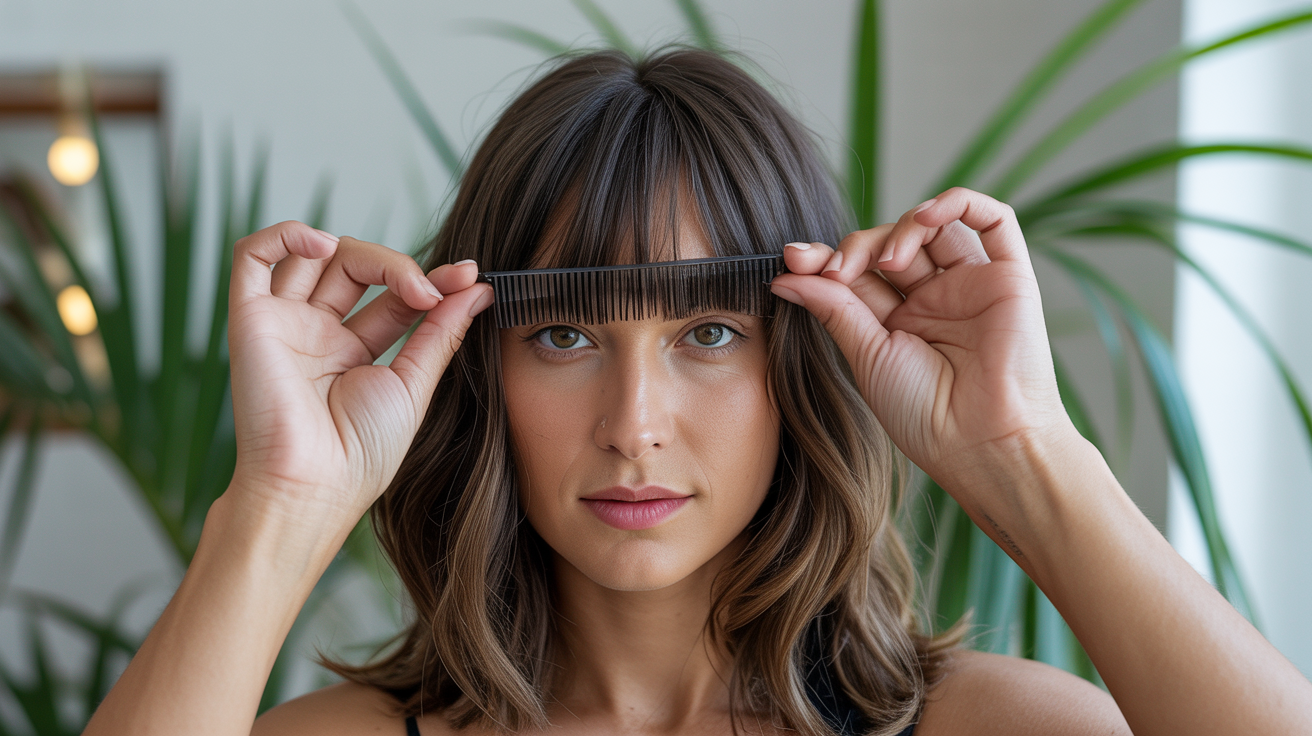
A lot of tutorials make this look effortless. It's not quite effortless, but it's doable if you're careful. The biggest risk is cutting too short, so everything below is designed to keep you from that mistake.
What you need:
- Sharp hair scissors (not kitchen scissors)
- A fine-tooth comb
- Two hair clips
- A mirror with good lighting
Step-by-step
- Start with dry hair. Curtain bangs shrink when they dry, and if you cut them wet you'll almost certainly end up shorter than you wanted.
- Part your hair down the middle. Section off a triangular piece at the front, from the center part to just past each eyebrow arch, about 2 inches deep into the scalp. Clip everything else back.
- Decide on your length before you touch the scissors. Hold the section down flat against your forehead. You want the finished length to sit at the outer corner of your eye or longer. Mark it mentally, then plan to cut an inch lower than that, because you can always take more off.
- Comb the section smooth and hold the hair between your index and middle fingers, angling your fingers diagonally so the hair is longest at the sides and shortest in the center.
- Point-cut along the bottom edge rather than cutting straight across. Point-cutting (snipping into the ends at an angle) gives a softer finish than a blunt line.
- Release, check the length, and only take more off if you're certain. Let it rest for five minutes before deciding; the hair relaxes slightly once you let go.
If you're nervous, cut less than you think you need to and revisit it the next day. Curtain bangs that are slightly too long look intentional. Curtain bangs that are too short look like a mistake. If you do end up cutting too short despite your best efforts, resist the urge to keep trimming to "even it out." A too-short section next to a longer one is fixable with styling (tucked behind the ear, worn with a headband) far more easily than hair that's already gone.
How to style curtain bangs
This is where people get stuck. Curtain fringe has a reputation for being high-maintenance, and honestly, it can be on wash day. Once you know a few techniques, the daily routine is five minutes or less.
Without heat
If your hair has any natural wave or texture, you can skip the heat tools most days. After washing, apply a tiny amount of a lightweight cream or mousse to damp bangs. Part them down the middle with your fingers, sweep each side away from your face, and let them air-dry. The result won't be perfectly smooth, but it'll be soft and lived-in, which is often better anyway.
With a round brush
This is the method that gives you the classic curtain bang shape. Work with a medium round brush and a blow dryer on medium heat.
- Rough-dry your bangs with your fingers first until they're about 80% dry.
- Pick up the front section with the round brush, rolling it slightly away from your face and directing the airflow downward along the hair shaft.
- Sweep to one side, then repeat on the other. The goal is a gentle outward curve, not a tight curl, not poker-straight.
- Finish with cool air to set the shape.
With a flat iron
For a sleeker result, a flat iron works well. Clamp the iron near the root of your bangs, then rotate it slightly outward (away from your face) as you pull it down. One or two passes per side is enough. If you're going for the retro 70s wave, you can curl the ends slightly back toward your face after straightening the top section.
Because bangs sit closest to the skin and get styled almost daily, they're also the section most likely to show heat damage first: dry ends, breakage at the length, or a dull, straw-like texture. The American Academy of Dermatology's guidance on heat styling habits recommends using the lowest effective heat setting, limiting how long a hot tool touches the hair, and reaching for heat no more than a few times a week where possible. In practice for bangs, that means one or two clean passes rather than going back over the same section repeatedly to chase a slightly better curve, and a heat protectant spray before every session with a flat iron or round brush.
Quick fixes for second and third-day bangs
Dry shampoo at the root, a quick blast with a hair dryer on low, or even holding a steaming mug close to the fringe (seriously) can reset the shape when you don't have time to start over.
If you're into updos on the days your bangs won't cooperate, a half-up style that leaves the bangs loose is almost always the answer. We have a full roundup of effortless updos for long hair that work alongside fringe.
Growing out curtain bangs
Every person who has ever had curtain bangs has gone through the grow-out. It takes roughly 3 to 6 months to get from eyebrow-length fringe to something you can fully tuck behind your ears, which lines up with how slowly hair actually grows: scalp hair grows about 0.5 to 1.7 centimeters a month on average, so a couple of inches of length is a real commitment, not a quick fix. There's no shortcut, but there are ways to make the wait less painful.
The awkward middle phase (months 1-2)
This is when the bangs are too short to stay behind your ears but too long to sit flat and look intentional. The best moves:
- Bobby pins and barrettes. Pin one or both sides back. A single gold clip swept to one side looks deliberate rather than desperate.
- Braids. Even a simple two-strand twist along the hairline pulls the awkward fringe back and blends it into the rest of your hair. See more ideas in our guide to easy braided hairstyles anyone can master.
- Headbands. A thin elastic headband worn a few inches back from the hairline keeps the fringe off your face without the growing-out-bangs look.
Months 3-4
The fringe starts to behave more like face-framing layers. This is genuinely the nicest phase: you get most of the softening effect of curtain bangs without needing to style them every morning. Lean into it. By this point the ends usually clear the cheekbone, which means a simple middle part and a swipe of texturizing spray is often all the styling you need.
Keeping the shape intact while growing
Ask your stylist to trim only the center of the bangs (the shortest part) and leave the sides alone. This maintains the tapered shape as the overall length grows, so it looks like a style choice rather than neglect. A trim every 6 to 8 weeks on just that center section, roughly a quarter inch at a time, keeps the taper looking deliberate instead of letting the whole fringe grow out as one uneven block.
FAQ
Are curtain bangs hard to maintain?
They need styling on wash days, which adds 5 to 10 minutes to your routine. On other days, a quick pass with a dryer or some dry shampoo keeps them in line. Compared to blunt bangs, they're more forgiving; the side-swept shape hides a lot.
How often do curtain bangs need trimming?
Every 6 to 8 weeks if you want to keep them at the same length. If you're growing them out, you can skip trims or ask for a very conservative dusting on the center section only.
Can you get curtain bangs with thick hair?
Yes, but your stylist may need to thin out the section slightly so the fringe doesn't puff outward. Thick curtain bangs can look great; they just need a bit more product and sometimes a stronger hold to stay swept to the sides.
Do curtain bangs work with curly hair?
They can, but curly hair shrinks significantly when it dries, so what looks like cheekbone-length fringe wet can end up at mid-forehead dry. Cut longer than you think you need to. Many people with curly hair wear curtain fringe in a looser, more natural shape rather than trying to straighten it, and it looks good that way.
What's the difference between curtain bangs and face-framing layers?
Length and where they start. Curtain bangs begin close to the hairline and have a visible parted section at the forehead. Face-framing layers start farther back and blend more gradually into the rest of the hair. Curtain bangs are a type of fringe; face-framing layers are more of a cut technique. As curtain bangs grow out, they gradually become face-framing layers, which is why the grow-out phase is actually pretty manageable.
Will curtain bangs work if I have a cowlick near my hairline?
Usually, with a slight adjustment. A cowlick tends to push hair in one direction as it dries, so ask your stylist to cut your bangs a touch longer on the side the cowlick pushes toward, and dry them in the direction the cowlick wants to go rather than fighting it. Trying to force a cowlick flat with product alone tends to fail by midday; working with the natural direction holds up much better.
Do curtain bangs need special products, or will my regular routine work?
Your regular routine mostly works. The one addition worth making is a lightweight heat protectant if you're using a round brush or flat iron on them regularly, since bangs get more repeated heat exposure than the rest of your hair. A small amount of finishing cream or a flexible-hold spray keeps them in place without the crunch of a stronger hairspray.